HOME
ABOUT OVL
CONTACT OVL
ASTRONOMY FAQs
ASTRONOMICAL
TELESCOPES
ASTRONOMICAL
ACCESSORIES
BINOCULARS SPOTTING SCOPES
& MONOCULARS
MICROSCOPES & METERS
QUICK FIND
PRODUCT SELECTOR
Types of Telescopes
Home > Introduction to Telescopes > Types of Telescopes
View stockists
THE GALLERY
LINKS
MANUALS
PRODUCT NEWS
PRICE LISTS
SPECIAL OFFERS
ORDER CATALOGUE
”I have used a great number of telescopes; some are good, some mediocre and some bad. To me the Sky-Watcher range of instruments are very good indeed, and suited to amateurs of all kinds – and they are not priced out of the market! Excellent value.
Use them and enjoy them.“
Sir Patrick Moore CBE FRS
Note: The Sky-Watcher telescope models and mountings that have been tested, endorsed and recommended by Sir Patrick Moore are labelled accordingly in their respective sections on this website.
Sir Patrick Moore CBE FRS

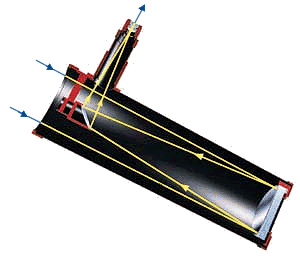
The Newtonian Reflector

This most common type of reflector telescope uses a concave objective mirror (primary mirror) at the back of the tube and a secondary mirror, which directs the light to the eyepiece.

Since the light rays entering the telescope reflect off the mirrors and don't pass through the glass, no false colour is produced. Orientation of the image is not important for astronomy so the image is left uncorrected.

The Newtonian reflector represents excellent value for money as typically they offer more aperture for a given price than other types of telescope.


<BACK TO TOP OF PAGE>
. . . . . . . . . . . . . . . . . . . . . . . . . . . . . . . . . . . . . . . . . . . . . . . . . . . . . . . .

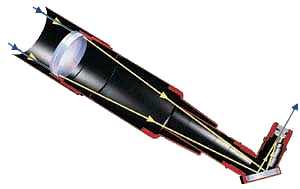
The Refractor

Refracting telescopes have an objective lens at the front of the tube. The light exits out through the back of the tube to the eyepiece. Since many observations are made high in the sky, a right-angle diagonal is used to avoid neck strain. This also provides an upright image making them suitable for terrestrial observations. A refractor has several advantages over other designs. The tubes are enclosed so that dust and moisture do not enter the tube, they have fixed optics that do not normally require collimation, and they do not have a central obstruction which reduces the light entering the tube. A refractor typically will give higher quality images of planets than other telescopes of similar aperture.


<BACK TO TOP OF PAGE>
. . . . . . . . . . . . . . . . . . . . . . . . . . . . . . . . . . . . . . . . . . . . . . . . . . . . . . . .

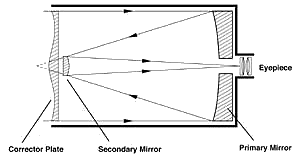
The Catadioptric

Telescopes using a combination of both mirrors and lenses are called catadioptrics. There are many different designs. Examples of these are the Schmidt-Cassegrain and the Maksutov-Cassegrain.

Usually a full aperture lens is used to correct aberrations in a compound reflecting telescope. The corrector lens also increases the performance of the instrument as air currents are eliminated. The main advantage of the design is that, because the light path is folded back on itself, it provides a very portable, short physical length telescope with a long focal length.

Original image
Inverted image seen through a reflector
Mirror reversed image seen through a refractor
Astronomical Objects do not require a telescope with erecting views as there is no 'Up' or 'Down' in space.

<BACK TO TOP OF PAGE>
. . . . . . . . . . . . . . . . . . . . . . . . . . . . . . . . . . . . . . . . . . . . . . . . . . . . . . . .

Telescope Mountings

A mounting with a tripod is necessary to point a telescope at its target, and to hold it there securely. A larger, sturdier mount is necessary for heavier telescopes. There are two basic types of mountings, and each is suitable for different applications.


<BACK TO TOP OF PAGE>
. . . . . . . . . . . . . . . . . . . . . . . . . . . . . . . . . . . . . . . . . . . . . . . . . . . . . . . .

AZ-3 Alt-Azimuth Mount
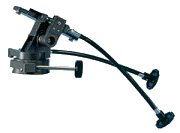
The Alt-Azimuth Mount

The Alt-azimuth mounting is a simple system which moves in two directions; sideways, and up and down, and is sometimes provided with slow motion cable controls to accurately point the telescope. This type of mounting is ideal for terrestrial observations and can also be of use for basic astronomical observations.


<BACK TO TOP OF PAGE>
. . . . . . . . . . . . . . . . . . . . . . . . . . . . . . . . . . . . . . . . . . . . . . . . . . . . . . . .

EQ3-2 Equatorial Mount
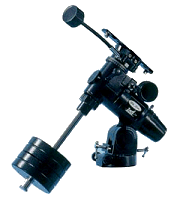
The Equatorial Mount

There are several different models of equatorial mount offered in this website, and the principle of all of them is the same. The principle is to correct for the rotation of the Earth with one motion during astronomical observations. the Earth's rotation causes objects to rise in the East, follow a circular path across the sky and set in the West. When using an astronomical telescope at high power, it will be only take approximately 30 seconds for the object to move out of the field of view. The equatorial mounting allows the telescope to track the objects and to keep the image in the centre of the eyepiece. When the equatorial mount is correctly aligned, tracking can be achieved either by turning a gear manually or with a motor drive which tracks objects automatically.


<BACK TO TOP OF PAGE>
. . . . . . . . . . . . . . . . . . . . . . . . . . . . . . . . . . . . . . . . . . . . . . . . . . . . . . . .


The prices listed on this website are U.K. suggested retail prices (SRP) including VAT for reference purposes only
and that prices may vary from dealer to dealer. Please contact your nearest stockist for firm pricing information.
As we are purely a distributor, we regret we are unable to sell directly to the public.
Specifications subject to variation due to later production changes. E&OE.

Skywatcher products Tal products Helios products Acuter products Zenith products

Optical Vision Ltd
Unit 3, Woolpit Business Park, Woolpit, Bury St. Edmunds, Suffolk IP30 9UP, England
Telephone: +44 (0)1359 244 200 Fax: +44 (0)1359 244 255
Email: info@opticalvision.co.uk


©Optical Vision Ltd 2007. No part of this website may be reproduced without the written permission of OVL


website designed by mi

EMAIL
AUTO-TRACKING TELECOPES
CHILDREN'S TELESCOPES
TABLETOP / TRAVEL TELESCOPES
NEWTONIAN REFLECTOR TELESCOPES
DOBSONIAN TELESCOPES
MAKSUTOV-CASSEGRAIN TELESCOPES
REFRACTOR TELESCOPES
SHORT TUBE REFRACTOR TELESCOPES
ED REFRACTOR TELESCOPES
TELESCOPE MOUNTINGS
TELESCOPE ACCESSORIES
SKYWATCHER TELESCOPE REVIEWS
EVOSTAR ED APOCHROMATIC REFRACTOR TELESCOPES
MAKSUTOV-CASSEGRAIN TELESCOPES
COMPUTERISED GO-TO TELESCOPE MOUNTINGS
PRO-SERIES TECH INFO
EQUINOX ED APOCHROMATIC REFRACTOR TELESCOPES
SKY-WATCHER PRO-SERIES TELESCOPE REVIEWS
NEWTONIAN REFLECTOR TELESCOPES
KLEVZOV-CASSEGRAIN TELESCOPES
REFRACTOR TELESCOPES
GENERAL ACCESSORIES
TELESCOPE MOUNTINGS
TAL TELESCOPE REVIEWS
SKY-WATCHER TELESCOPE MOUNTS
TAL TELESCOPE MOUNTS
ACUTER MOTORISED TRIPOD
INTRODUCTION TO TELESCOPES
SKYWATCHER TELESCOPES
SKY-WATCHER PRO-SERIES TELESCOPES
TAL TELESCOPES
TELESCOPE MOUNTINGS
BRASS TELESCOPES
TELESCOPE MOUNTINGS
TELESCOPE ACCESSORIES
ROOF PRISM BINOCULARS
COMPACT PORRO PRISM BINOCULARS
PORRO PRISM BINOCULARS
THEATRE/OPERA GLASSES
WATERPROOF BINOCULARS
OBSERVATION BINOCULARS
ROOF PRISM BINOCULARS
HELIOS BINOCULARS
ACUTER BINOCULARS
PHOTO/VIDEO TRIPODS
BINOCULAR ACCESSORIES
HELIOS DRAW TELESCOPES
HELIOS SPOTTING SCOPES
HELIOS MONOCULARS
ROOF PRISM MONOCULARS
ACUTER SPOTTING SCOPES
ACUTER CMOS DIGITAL IMAGERS
BRASS TELESCOPES
HELIOS SPOTTING SCOPES & MONOCULARS
SKYWATCHER SPOTTING SCOPES
ACUTER SPOTTING SCOPES & MONOCULARS
PHOTO/VIDEO TRIPODS
SPOTTING SCOPE ACCESSORIES
ZENITH STUDENT MICROSCOPES
ZENITH LABORATORY MICROSCOPES
ZENITH STEREOSCOPIC MICROSCOPES
EDUCATIONAL D.C. AMMETERS & VOLTMETERS
TYPES OF TELESCOPES
VIEWING TIPS
GLOSSARY
DEEP SKY
NATURE STUDY
PLANETS